Categories
- Pipe & Tube (18)
- Flange & Fitting (97)
- Fastener & Gasket (12)
- Valve & Pump (18)
- Base Material (11)
- Equipment (12)
- Application (31)
- Technical (110)
ASTM A707 L5 Class3 forged flanges are manufactured to major dimensional standards including ASME B16.5, ASME B16.47 Series A & B, and NORSOK L-005, making them suitable for high-pressure oil & gas, offshore, and cryogenic applications, even in demanding sour service conditions. Their strength stems from a unique copper precipitation hardening mechanism within an ultra-low carbon Ni-Cu-Nb alloy system. This provides an exceptional combination of high strength (min. 415 MPa yield strength) and guaranteed impact toughness at -62°C (-80°F), along with excellent welding performance.
| Element | Composition, % |
|---|---|
| C | ≤0.07 |
| Mn | 0.40-0.70 |
| P | ≤0.025 |
| S | ≤0.025 |
| Si | ≤0.35 |
| Ni | 0.70-1.00 |
| Cr | 0.60-0.90 |
| Cu | 1.00-1.30 |
| V | ≤0.05 |
| Nb | ≥0.03 |
| Mo | 0.15-0.25 |
| Tensile Properties | Requirements |
|---|---|
| Tensile Strength min. MPa [ksi] | 515 [75] |
| Yield Strength min. MPa [ksi] | 415 [60] |
| Elongation in 2", min. % | 20 |
| Reduction of area, min. % | 40 |
| Hardness, HBW | 156-235 |
| Cv energy absorption, min, avg, ft-lbf [J] | 50 [68] |
| Cv energy absorption, min, ft-lbf [J] | 40 [54] |
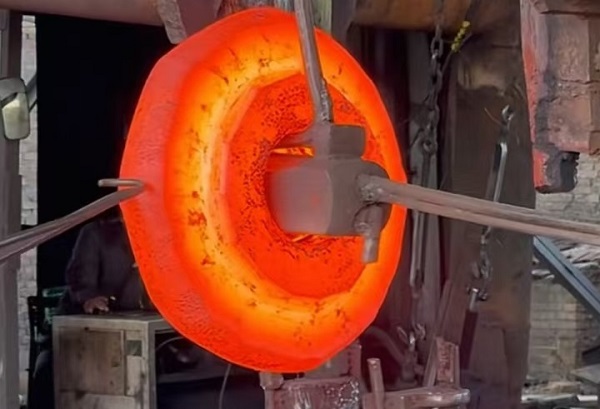
Open-die forging process for the manufacture of ASTM A707 L5 flanges.
The ASTM A707 L5 Class 3 material can undergo various heat treatments, including annealing, normalizing, quenching and tempering, normalizing and tempering, normalizing with precipitation hardening, or quenching and precipitation hardening. However, Precipitation Hardening is the central and most critical process for achieving its defining properties.
The precipitation hardening treatment specifically involves heating the forging to a temperature range of 538°C to 677°C (1000–1250°F), holding it for a minimum of 30 minutes, and then cooling at any convenient rate. The fundamental purpose of this process is to significantly increase the yield strength (reaching 75-100 ksi for modified grades) through the fine precipitation of epsilon-copper particles within the ferrite matrix, while largely preserving toughness.
This unique heat treatment mechanism enables the material to simultaneously meet the requirements for high strength, good low-temperature toughness, and excellent welding performance. It is particularly suited for manufacturing large, critical forgings intended for demanding service environments, such as those containing hydrogen sulfide (sour service).
ASTM A707 L5 Class 3 flanges are engineered primarily for petroleum and natural gas pipeline systems, particularly where excellent low‑temperature toughness (down to –80 °F / –62 °C) is required. This grade guarantees toughness at –62 °C, delivers a robust minimum yield strength of 415 MPa, offers excellent welding performance with little or no preheat, and is available in chemistry‑modified variants for sour service applications. It is widely employed in demanding offshore oil and gas environments, low temperature pressure vessels, LNG facilities, and Arctic or cold climate pipelines. As large diameter forgings, ASTM A707 L5 Class 3 is the material of choice for critical junctions in severe service conditions, where high strength (minimum 75 ksi / 515 MPa for Class 3) must be preserved at low ambient temperatures. This combination makes it a premier, cost effective engineering solution for large diameter forged flanges where safety, reliability, and ease of fabrication in extreme environments are paramount.
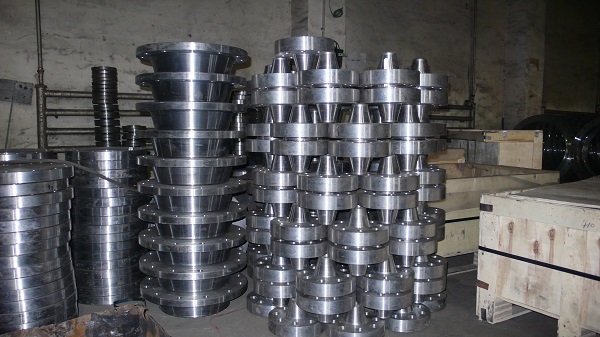
A707 L5 Class3 ASME B16.5, CLASS600 SCH80 weld neck flanges shipped to Chile.
The L5 alloy grade offers excellent welding performance. Its low carbon equivalent minimizes cold cracking susceptibility, frequently allowing fabrication without preheat. However, hardness in the weld zone can increase as a result of copper aging, necessitating specific controls for use in sour environments.
The standard high-strength A707 L5 (“MOD” variant) provides good base metal hardness (<240 Hv30), making it suitable for moderate sour environments. However, welded HAZ hardness often exceeds 280 Hv10, which may not meet typical sour service hardness limits (e.g., <22 HRc or ~250 Hv). For severe H₂S service, specially modified A707 SSC grades have been developed. These variants feature adjusted chemistry (e.g., reduced Mn, Nb) and optimized aging/overaging treatments to control HAZ hardness below 260 Hv10, thereby providing superior sulfide stress cracking resistance as demonstrated in NACE Method A tests.